How CFOs can Tackle Rising Healthcare Spending
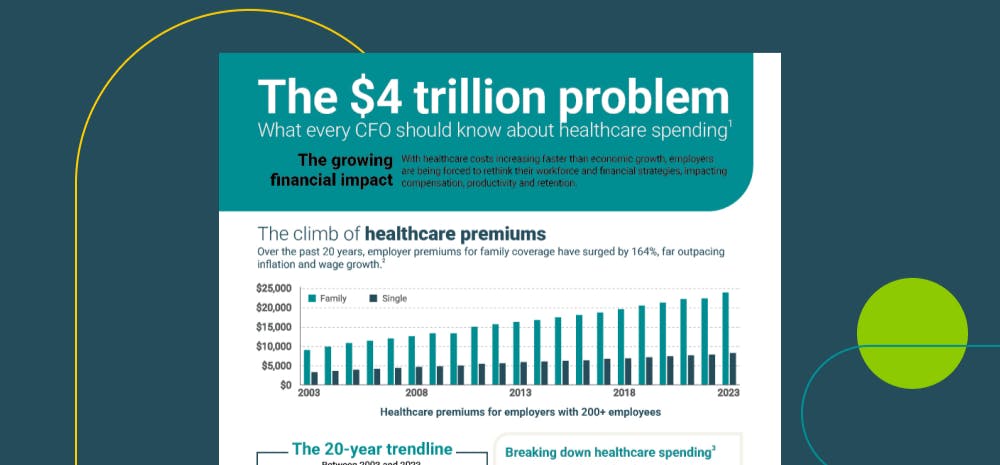
As healthcare expenses continue to rise, many self-funded employers are starting to see healthcare not only as an HR responsibility, but as one of the most powerful financial drivers in the organization.
Over the last two decades, healthcare spending in the United States has increased by more than 250%, growing faster than GDP, wages, and inflation. Today, healthcare represents more than 17% of the U.S. economy. These trends make it clear that healthcare belongs in financial planning discussions, and CFOs need a seat at the table. When left unmanaged, healthcare becomes a material business risk.
Get the infographic: Healthcare cost crisis
A hidden threat to financial performance
Rising benefit costs are no longer an abstract concern. With U.S. healthcare spending up 250% over 20 years, the ripple effects across employer budgets are significant.
17.3% of U.S. GDP
Healthcare spending now accounts for 17.3% of the national economy, nearly twice the share seen in many other developed countries.
83% self-funded plans
Most large employers self-fund their health plans, which means they directly absorb the financial impact of higher claims and utilization.
Employers pay up to 84%
Organizations continue to cover between 70% and 84% of premium costs, a model that becomes harder to sustain without stronger cost management.
$23,968 for family coverage
The average cost of employer-sponsored family coverage has reached $23,968 per employee, placing increasing strain on benefits budgets.
Uncover how this impacts your organization
Moving beyond the status quo
When employers rely on insurance carriers to guide employees through healthcare, or leave plan oversight solely to HR teams, they sacrifice insight and control over one of their largest expenses.
This approach often leads to higher costs, administrative burden, lower productivity, and challenges with retention. A different path is possible when healthcare is managed strategically rather than reactively. Finance and HR leaders can work together to improve outcomes and protect the organization’s financial health.
Why collaboration matters
As the leading independent navigation and care coordination platform, Quantum Health works with self-insured employers to lower healthcare costs while improving the employee experience. Our platform supports employees throughout their care journey and integrates smoothly with existing benefits programs.
Our model delivers measurable impact by helping organizations:
- Intervene early to prevent high-cost claims from escalating
- Connect employees with high-quality, cost-effective care
- Reduce friction across HR, finance, and the overall employee experience
We are more than a cost management vendor. We are a partner committed to better health outcomes for your people and stronger financial performance for your business.
Ready to take control over rising healthcare spend?
Let us show you how.


